
Cosmetic Production Scale-Up: What Happens Behind the Scenes?
What Happens Behind the Scenes When Scaling Cosmetic Production?
Let’s stir up some magic in the lab with today’s hot topic: what actually happens behind the scenes when a cosmetic formula moves from a cute little laboratory beaker into full cosmetic production.
From the outside, scaling cosmetic production can sound wonderfully simple. You made 200g of face cream. You need 100 kg. So surely we multiply every ingredient, find an enormous mixing bowl and get on with it, right?
Oh, my lovely beauty founders. If only.
One of the most important things to understand about cosmetic manufacturing is that scaling a formula is not the same thing as multiplying a formula. The percentages may remain identical, but the physical manufacturing process changes dramatically as batch size increases.
Heating changes. Cooling changes. Mixing changes. Shear changes. Ingredient incorporation may change too. Even how long it takes a powder to disappear into your water phase can change.
This is why scale-up is such an important stage between cosmetic formulation development and reliable commercial manufacturing.
So, come behind the laboratory doors with me. Coffee in hand. Lab coat optional (just this once).
A 200g Formula and a 100 kg Formula Do Not Behave the Same Way
Imagine making soup for two people versus soup for 200.
Technically, you could multiply the recipe. But suddenly you are working with a different pot, different heating capacity, different stirring equipment and a very different amount of soup that needs to move around that vessel.
Cosmetics behave similarly, except we are considerably more concerned about droplet size, polymer hydration, viscosity, emulsion stability and whether your luxury moisturiser accidentally turns into cottage cheese.
During small-scale cosmetic formulation development, the formulator can observe the product very closely. A 500g or 1kg laboratory batch responds quickly to heating and cooling. Ingredients can be incorporated with relatively small laboratory mixers, and the entire contents of the vessel can circulate efficiently.
Move that same formula into a 50kg or 100kg manufacturing vessel and the physics change.
This is where cosmetic formulation scale-up really begins.
Mixing Speed Is Only Part of the Story
One of the biggest cosmetic scale-up challenges is mixing.
A laboratory formula may have been homogenised at a particular RPM, but simply using exactly the same RPM on a much larger machine does not necessarily reproduce the same processing conditions.
Production equipment has different rotor diameters, impeller sizes, vessel geometries and power capabilities. The actual forces being applied to the product can therefore be very different.
For high-shear mixing in particular, parameters such as rotor tip speed, shear rate, mixer geometry, power input, product viscosity and the rate at which the entire batch circulates through the mixing zone can influence the finished result.
That matters because mixing affects things such as emulsion droplet size, powder dispersion and the structure of the finished cosmetic.
This is why professional cosmetic manufacturing laboratories do not simply write “mix for five minutes” on a batch sheet and hope for the best. What may require 5 minutes in a 200g batch, may well require over an hour in a much larger batch size.
A manufacturing process needs to define appropriate equipment, speeds, stages, temperatures, additional methods and mixing times that can consistently reproduce the product.
And yes, sometimes the glamorous world of beauty product manufacturing involves standing beside a vessel staring intensely at a vortex.
Nobody puts that part on Instagram.
Heating 100 kg Is Very Different From Heating 1 kg
Temperature is another major scale-up consideration.
Small laboratory batches heat and cool comparatively quickly. Larger cosmetic batches contain considerably more thermal mass, which means getting the entire batch to the required temperature can take much longer.
The same applies when cooling. This becomes particularly important for emulsions.
Imagine that your laboratory procedure says to heat the oil and water phases separately to approximately 75°C, combine them, homogenise and then begin cooling.
At 1 kg, moving through those steps can be relatively quick.
At manufacturing scale, both phases need to reach the required processing conditions throughout the batch. Then, once emulsified, tens of kilograms of hot product need to cool before temperature-sensitive ingredients, fragrances, preservatives or certain actives can be added.
Cooling too quickly, too slowly or unevenly can influence the final structure of some formulas.
Suddenly, temperature is not merely a number in the formulation instructions. It becomes part of the manufacturing strategy.
Your Thickener Might Decide to Humble Everyone
Now we need to discuss one of my favourite scale-up troublemakers: rheology. Or, in friendlier language, the way your product flows and behaves.
Gums, polymers and other cosmetic thickeners can be incredibly sensitive to how they are incorporated. Some need careful dispersion before hydration. Some form lumps when added too quickly. Some respond differently depending on electrolytes, surfactants, pH or shear.
In a laboratory beaker, you might sprinkle 5 grams of polymer into your batch beautifully.
At production scale, that could become 500 grams or several kilograms.
Dumping several kilograms of powder directly into liquid is a wonderful way to discover what cosmetic chemists mean by “fish eyes”, those delightful dry lumps of powder surrounded by partially hydrated polymer that refuse to cooperate with your production schedule.
So the manufacturing process may need to change. Powders might require pre-dispersion, stronger agitation, high-shear processing or a different order of incorporation.
The formula has not necessarily changed. The process has.
That distinction is essential when scaling skincare, haircare and other cosmetic products.
Ingredient Addition Rates Suddenly Matter
At small scale, adding an ingredient “slowly” might mean pouring it into the beaker over 20 seconds. Try applying the same logic to 8 kg of something during production.
Ingredient addition rate becomes much more important as production volumes increase, particularly with emulsifiers, surfactants, powders, polymers and materials that can shock or destabilise the system when incorporated incorrectly.
Even the location where an ingredient enters the vessel can matter.
If powder sits beautifully on the surface instead of being drawn into the mixing zone, you may get uneven dispersion. If oil is incorporated into an emulsion too quickly, the mixer may struggle to process it efficiently. If a foaming surfactant is introduced with excessive agitation, congratulations, you may now own 80 kg of bubbles.
Scale-up therefore involves learning how the formula interacts with the production equipment, not simply what ingredients belong inside it.
Then There Is Everyone’s Favourite Guest: Air
Air incorporation is one of those manufacturing challenges that sounds harmless until you see it happening.
High-viscosity creams, gels, conditioners and surfactant products can trap air during mixing. Excessive aeration can make the product appear lighter or thicker than expected, interfere with accurate filling, create unattractive bubbles and complicate weight or volume control.
The production team therefore needs to manage not just whether the product is mixing, but how it is moving.
Mixer position, impeller selection, speed, vessel geometry and the stage at which high shear is used can all influence aeration.
Sometimes a formula that looked beautifully smooth in the development laboratory suddenly emerges from production looking like mousse.
Delicious perhaps, but generally not what was written in the product brief.
Scale-Up Continues After the Mixing Stops
Here is something beauty founders often underestimate. The bulk product being successfully manufactured is not the end of production.
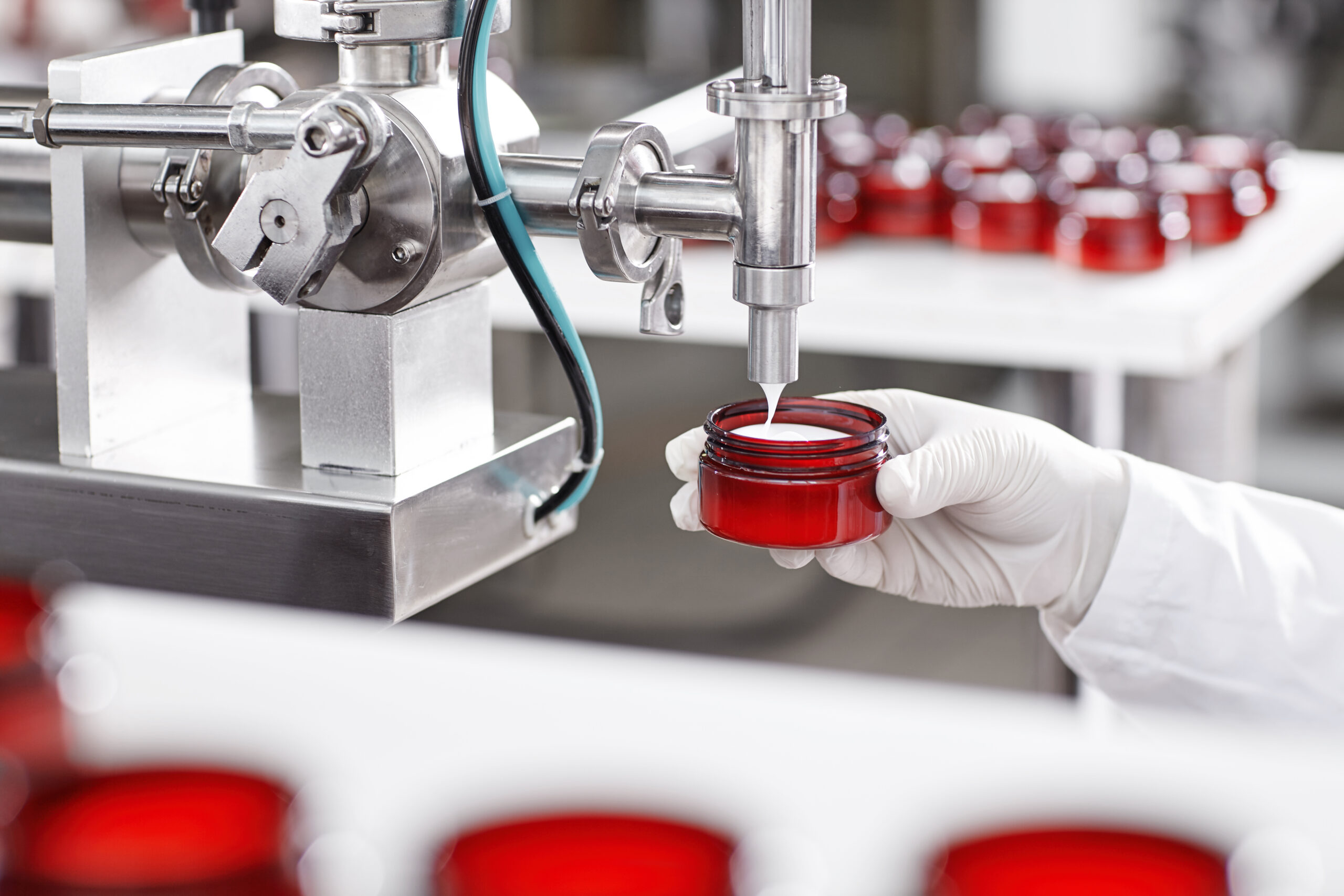
You still have to get it out of the vessel and into the filling machine. Everyone thinks of the mixing equipments, the filling equipments but how does the product move from one to the other? At 200g, it’s, easy, you just pour from the beaker to the packaging. At 1kg, you pour straight from the beaker to the small manual filling machine. But how are you going to lift 100kg vat? You need to think of transfer tubes and pumps as you scale. Which ones to get, which material, width of diameter, what type of viscosity it can handle etc.
A lightweight shampoo may transfer relatively easily through pumps and hoses. A dense hair mask, clay product or buttery body cream can be an entirely different adventure. Will the filling equipment handle the viscosity?
Then comes packaging.
A formula might be perfectly stable and absolutely gorgeous, yet extremely difficult to fill into the packaging the brand selected.
Very thick products may struggle through narrow bottle openings. Foaming products can create filling problems. Products filled too hot may change packaging shape or final texture. Products filled too cold may become difficult to pump.
This is why packaging compatibility should be considered much earlier than five minutes before production starts.
Your formula and packaging need to work together.
Pilot Batches Exist for a Reason
I cannot stress enough the importance of moving through a pilot batch first before jumping into 50-100kg’s worth of product.
A pilot batch sits between tiny R&D batches and larger commercial production and allows the manufacturing team to observe how the formula responds when equipment and processing conditions begin to resemble full production more closely.
This is where issues with mixing, viscosity, aeration, heating, cooling, ingredient incorporation and filling may become visible.
It also gives the laboratory an opportunity to refine the manufacturing instructions.
Perhaps an ingredient needs to be incorporated more slowly. Maybe homogenisation needs adjustment. Perhaps the cooling stage takes considerably longer than expected. Maybe the finished cream is actually thicker (or thinner) in a larger production.
That information becomes part of understanding the product. Scale-up is not a sign that the original formula was bad. It is part of turning a laboratory formulation into a manufacturable cosmetic product.
Quality Control Becomes Even More Important
Once a production batch is completed, it is important to check whether what you produced actually matches the expected specifications.
Depending on the product and established specifications, quality-control checks may include appearance, colour, odour, pH, viscosity, density or other relevant characteristics. Samples should also be retained for microbial testing and reference.
For cosmetics manufactured for the EU market, manufacturing must comply with Good Manufacturing Practice under Regulation (EC) No 1223/2009. EN ISO 22716 is the harmonised cosmetic GMP standard used to support that framework.
And this is where batch records become incredibly important. Because you should be able to trace what raw materials were used, the quantities weighed, manufacturing steps, equipment, batch identification and relevant control information. Just in case there is a problem later down the line. If you can spot where that problem happened, you can take note and make sure to solve it for next time.
Because manufacturing is about reproducibility, not one perfect batch. In R&D, success can feel like making one beautiful formula. In manufacturing, success means being able to make it again. And again. And again. Professional cosmetic production is built around reproducibility.
Scale-Up Is Where a Formula Becomes a Real Product
There is something genuinely exciting about watching a formula move from a 1 kg laboratory batch into commercial cosmetic production.
It is also one of the reasons I always encourage beauty founders to understand that cosmetic development involves more than choosing exciting ingredients.
A fantastic commercial formula needs to be safe, stable, compliant, desirable, and scalable! That very specific and unique texture you saw on Instagram might look so cool to add to your line, but can YOU make it at scale easily and consistently? Do you have the proper equipment or do you have the budget to invest in it?
The next time you see a beautifully filled row of 500 shampoos, moisturisers or hair masks on a shelf, remember that the finished bottles are only the part you can see.
Behind them is an entire manufacturing process that has been developed to make sure bottle number 487 performs like bottle number 12, and that your next production batch behaves like the one your customers already know and love.
And that, my business girlies, is when a formula stops being something wonderful we made in a beaker and starts becoming a product a beauty brand can genuinely scale.
Here’s to formulas that work and brands that thrive!
From my lab to yours,
Rose





Add comment